
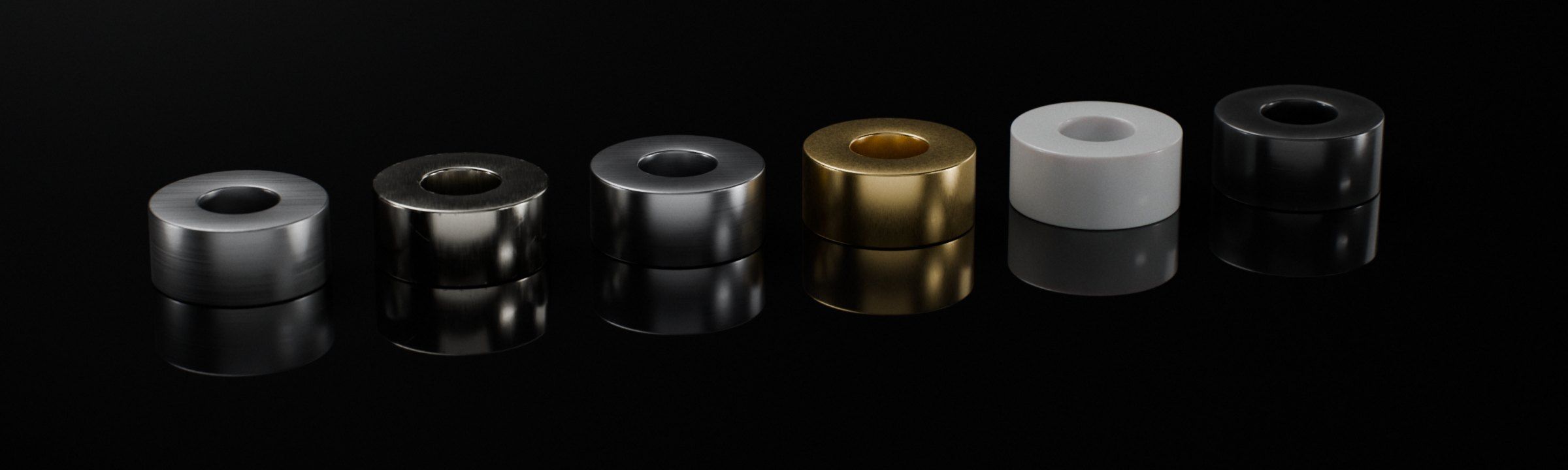
The same NdFeB ring magnet in six versions: passivated, Ni-Cu-Ni, titanium (PVD), gold, Parylene C (white), epoxy (black).
Capabilities
What we coat
Rare earth magnets almost always need a protective coating: NdFeB corrodes even in humid air, SmCo is brittle and tends to chip at the edges. In medical devices, the coating must also suit the environment in which the magnet works.
| Feature | BOMATEC |
|---|---|
Coatings for medical devices | Parylene C, Parylene N, gold, titanium |
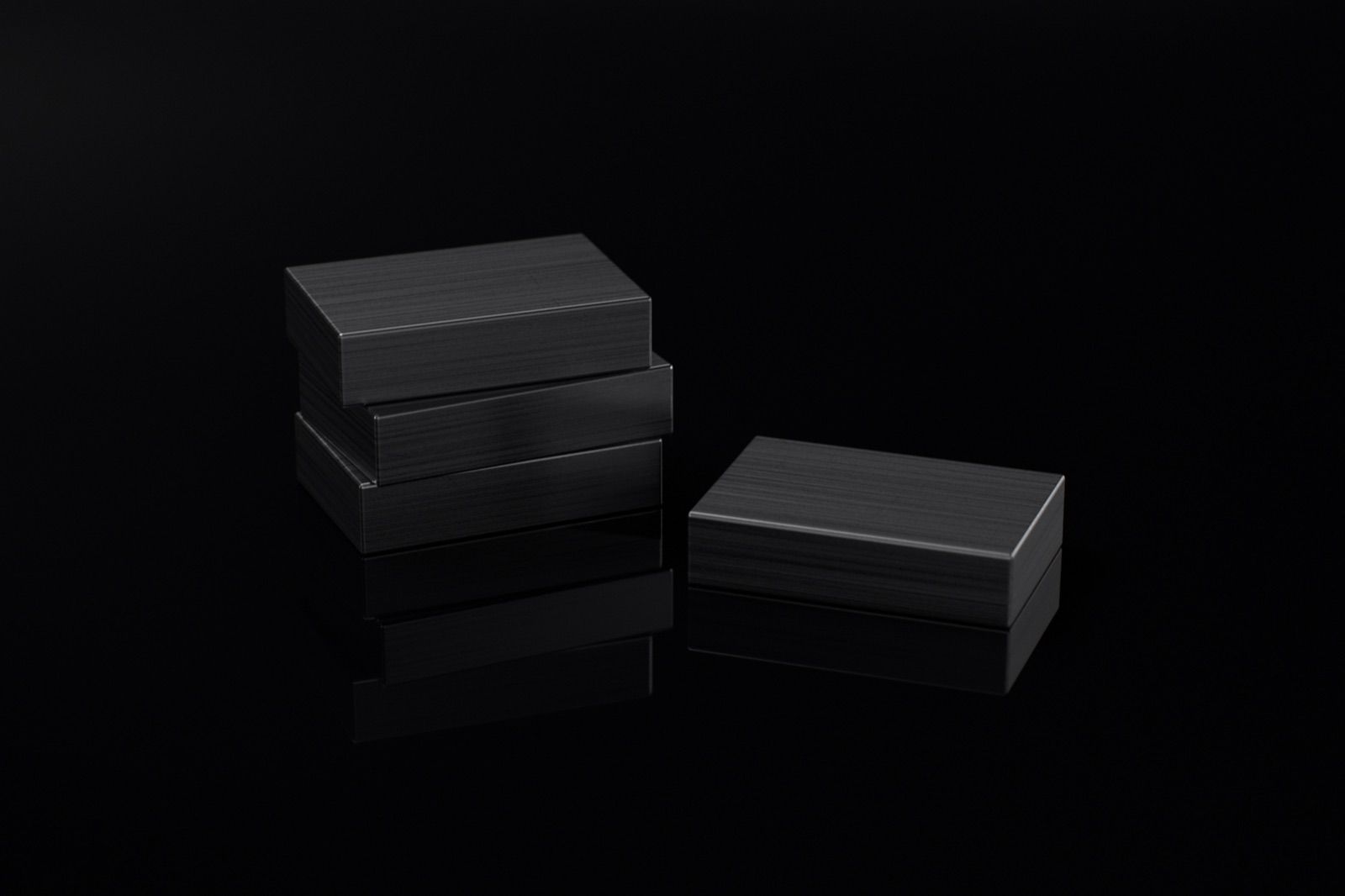
Standard coatings | Passivation, Ni-Cu-Ni, Ni-Cu-Ni with electroless nickel, Ni-Cu-Sn, zinc, epoxy (black, dark grey), Ni-Cu with epoxy |
Magnet materials | Sintered NdFeB and SmCo, plastic-bonded magnets |
Smallest coated parts | from approx. Ø 0.4 mm |
Coating thickness Parylene C | typically approx. 5 to 10 µm |
Layer structure gold | Nickel strike plus flash gold, approx. 10 µm in total. The gold layer itself is only a thin top coat. |
Biocompatibility | ISO 10993 evidence for Parylene C in preparation |
Cleanroom | ISO class 8 |
Process validation | IQ, OQ, PQ |
Traceability | to the raw material batch |
Samples | from 1 piece |
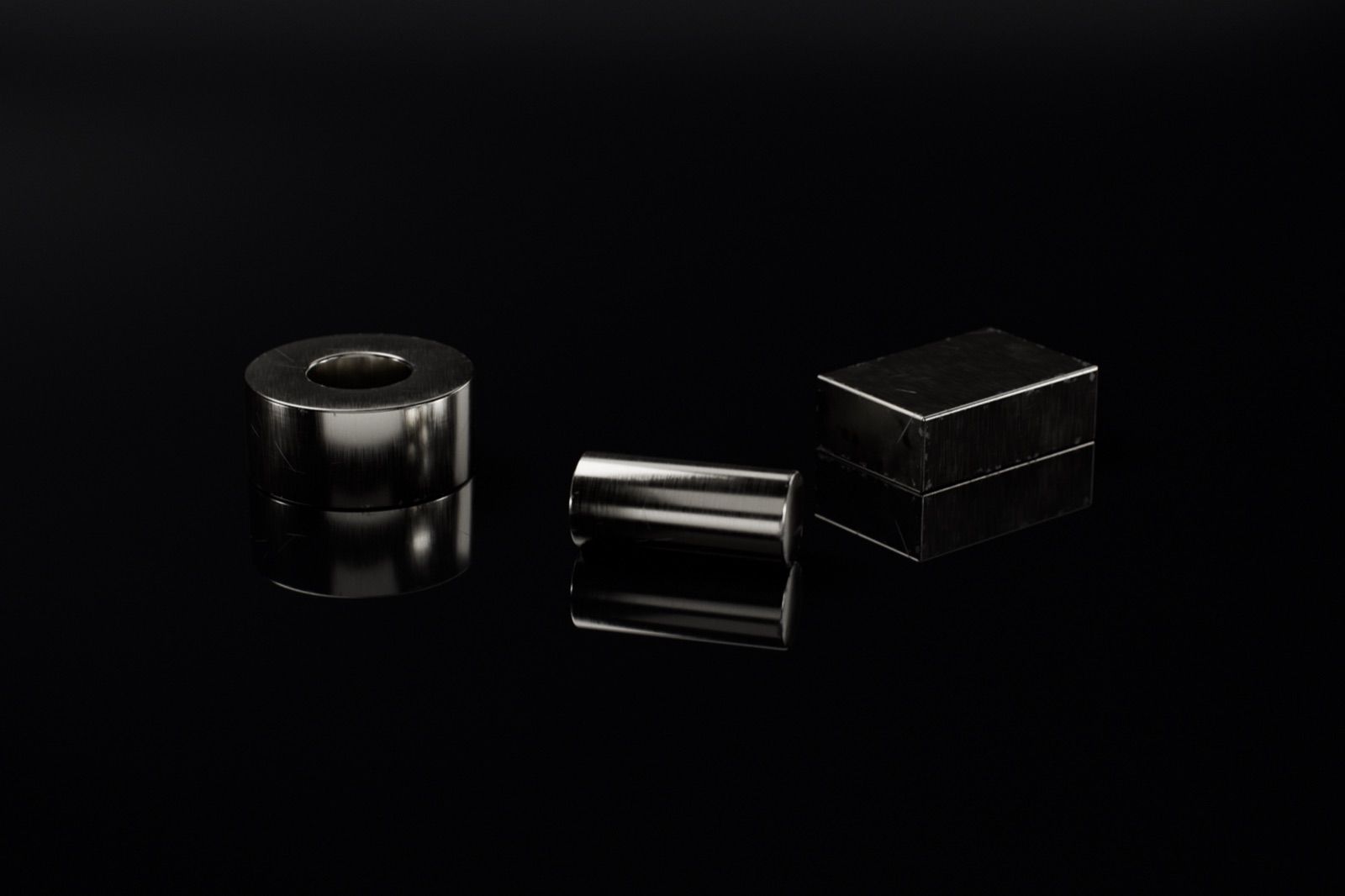
Uncoated: ground NdFeB. Whether a magnet can do without a coating depends on the material and the environment. Standard NdFeB corrodes even in humid air. Corrosion-resistant NdFeB grades (suffix /S) and SmCo can also do without a coating, depending on the application.
Ni-Cu-Ni: the standard coating for devices without body contact and for parts exposed to abrasion.
Standard coatings for NdFeB at a glance
Typical values for our standard coatings. The coating often limits the operating temperature more than the magnet grade does. We specify the exact coating thickness on the drawing.
| Coating | Typical coating thickness | Max. temperature | Corrosion test (minimum requirement) |
|---|---|---|---|
Passivation, also phosphated | 1 to 3 µm | approx. 200 °C | none, protection only for transport and storage |
Ni-Cu-Ni | 10 to 30 µm | approx. 220 °C | 24 h pressure cooker test |
Ni-Cu-Ni with electroless nickel | 15 to 25 µm | approx. 220 °C | 24 h pressure cooker test |
Ni-Cu-Sn (tin) | 10 to 20 µm | 120 °C | 24 h pressure cooker test |
Zinc, blue or coloured | 4 to 20 µm | 120 °C | 24 h (blue) or 48 h (coloured) salt spray test |
Epoxy | 10 to 35 µm | 200 °C | 96 h salt spray test |
Ni-Cu with epoxy | 15 to 50 µm | 200 °C | 96 h salt spray test |
Salt spray test to DIN EN ISO 9227 (NSS, 35 °C, 5 % NaCl). Pressure cooker test to JESD22-A102E (121 °C, 2.05 bar, 100 % relative humidity). We compare Parylene, gold and titanium for medical devices further down in the comparison.
Comparison
Which coating for which requirement?
We choose the coating by operating conditions, not from a catalogue. The table shows which way we tend to go in typical cases. The final choice depends on your test requirements.
| Requirement | Our recommendation | Why |
|---|---|---|
Limited space, micromagnet | Parylene C or N | Thin, uniform coating that also covers edges and bores |
Electrical insulation | Parylene or epoxy | Both insulate. Parylene reaches a high dielectric strength with just a few micrometres; epoxy builds up thicker and costs less. |
Short-term body contact, e.g. instruments | Parylene C or gold | Both are established in medical technology. The choice depends on abrasion, sterilization and test plan. |
Long-term implant | Encapsulation in titanium or polymer, coating as a second barrier | With permanent contact, a coating alone is rarely enough |
Repeated steam sterilization | NdFeB or SmCo, with a suitable coating | Steam sterilization at 134 °C also works with NdFeB if grade and design suit the temperature. SmCo loses less when hot. We check the coating's resistance to steam together with you. |
Abrasion and impact | Ni-Cu-Ni or epoxy | Parylene is thin and comparatively soft. We generally advise against press fits: sintered magnets are brittle and can break in the process. Better to bond or overmold them. |
Devices without body contact | Ni-Cu-Ni or epoxy | Proven, inexpensive, readily available |
When we advise against Parylene
- With abrasion, impact or contact with hard mating surfaces
- When the magnet is pressed in
- With long chemical exposure without defined test conditions
Gold and nickel
Gold is not applied directly to NdFeB but to a nickel intermediate layer: nickel strike plus flash gold, about 10 µm in total. The gold layer itself is only a thin top coat. If nickel is an issue for your application, we clarify the layer structure in advance. With micromagnets, the thickness and uniformity of the coating are demanding, so we define them in the project.
Process
How Parylene is applied
Parylene is deposited from the gas phase in a vacuum. The magnet itself stays at room temperature and loses no magnetization through the coating.


01 · Vaporization
The powdered dimer is heated and passes into the gas phase.

02 · Pyrolysis
In the furnace, the dimer splits into reactive monomers. This high temperature affects only the equipment, not the magnet.

03 · Deposition
In the coating chamber, the monomers polymerize at room temperature as a uniform film on all surfaces.
Testing and documentation
What we test and document
| Test item | How we test |
|---|---|
Dimensions | On the coated part, 100 % on request |
Magnetic properties | On a standard test specimen from the same batch, as is usual in the industry |
Coating quality | Corrosion test as a minimum requirement, depending on the coating: 24 h pressure cooker test for Ni-Cu-Ni and Ni-Cu-Sn, 24 h or 48 h salt spray test for zinc, 96 h salt spray test for epoxy (see overview above) |
Coating thickness | To drawing |
Traceability | From the part to the raw material batch, with material certificate |
Cleanliness and packaging | Cleanroom ISO class 8, packaging as agreed |
FAQ
Frequently asked questions about coated magnets
Are neodymium and SmCo magnets biocompatible?
Not as bare material. For body contact they are coated, for example with Parylene C or gold, or encapsulated, for example in titanium. The manufacturer provides the evidence to ISO 10993 on the finished medical device. We supply the material and coating data for it.
Is Parylene C biocompatible?
Parylene C has been used in medical technology for decades, for example on implants and catheters. For our coating process, the evidence to ISO 10993 is in preparation. What counts in the end is the testing of the finished product.
Does the coating change the magnetic properties?
The magnetization stays unchanged because Parylene is deposited at room temperature. The coating does, however, increase the distance to the mating part. With tight air gaps, we therefore include the coating thickness in the design.
How thick is a Parylene coating?
We typically apply approx. 5 to 10 µm of Parylene C. For your application, we set the thickness according to the available space, insulation requirements and tolerances.
How small can coated magnets be?
We coat magnets from a diameter of approx. 0.4 mm. More on this on the page about micromagnets.
What quantity do you need for a coating?
Technically, one piece is enough. Because set-up and testing make up a large part of the cost, samples usually only pay off from a small batch size. We are happy to discuss this with you.

What we need for a quotation
For a coating, we mainly need the operating temperature, the media and the sterilization method, as well as the type and duration of body contact. From these we choose the coating and the material.
Talk to an expert
Your contact for medical technology
Talk to us about your project. We are happy to advise you personally.

Patrick Muschak
Sales Engineer Medical & Life Sciences

Philippe Scheuber
Head of Sales