

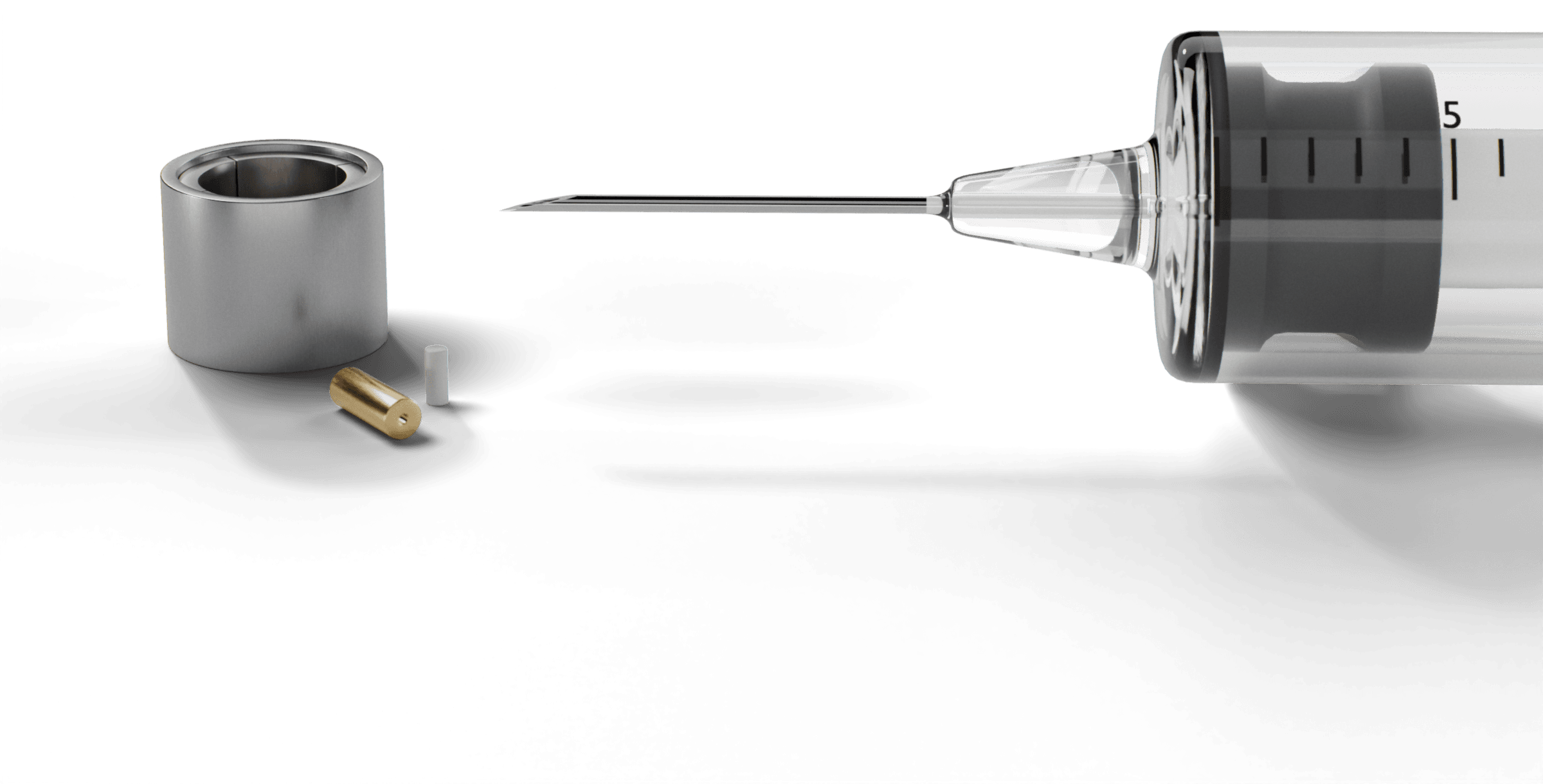
Size comparison with an insulin syringe. From the left: magnet assembly approx. Ø 4 mm, gold-plated ring magnet Ø 0.73 × Ø 0.16 × 2 mm, Parylene C coated rod magnet Ø 0.39 × 1 mm.
Capabilities
What we make
| Feature | BOMATEC |
|---|---|
Smallest outer diameter | approx. 0.4 mm |
Bores | achieved down to Ø 0.16 mm |
Geometries | Rod, ring, disc, block, segment, to drawing |
Materials | Sintered NdFeB and SmCo |
Magnetization | axial, diametrical |
Coatings | Ni-Cu-Ni, gold, Parylene C and N, titanium |
Inspection | Geometry on the part, 100 % on request; magnetic values on the batch |
Samples | from one piece |
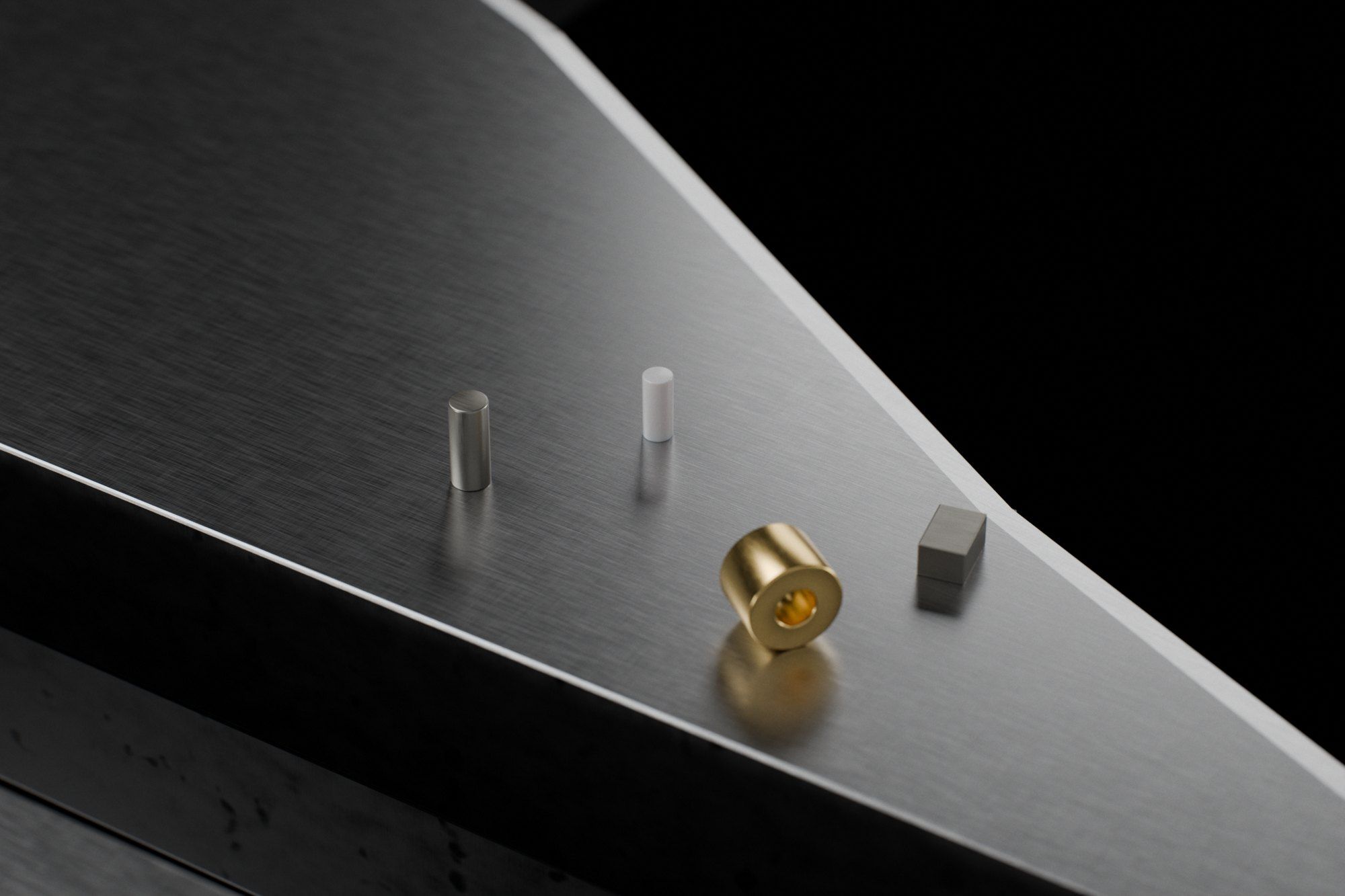
Micromagnets on the jaw of a calliper: rod magnets nickel-plated and with Parylene C, gold-plated ring magnet, nickel-plated block.
Miniaturization
What is different about micromagnets
A magnet 0.4 mm in diameter is not a scaled-down 10 mm magnet. At these dimensions, effects become important that hardly matter for larger parts.


Edges and breakage
Sintered magnets are brittle. On micro parts every chipped edge matters, so we design chamfers and machining accordingly.

Surface and coating
The smaller the part, the larger the share of surface. Here a coating of a few micrometres is already part of the tolerance.

Magnetization
Small parts need suitable fixtures so that direction and pole pitch are right. We check the design in advance by FEM simulation.

Measurement
We measure geometry on the part. As is usual in the industry, we determine magnetic properties on a standard test specimen from the same batch.
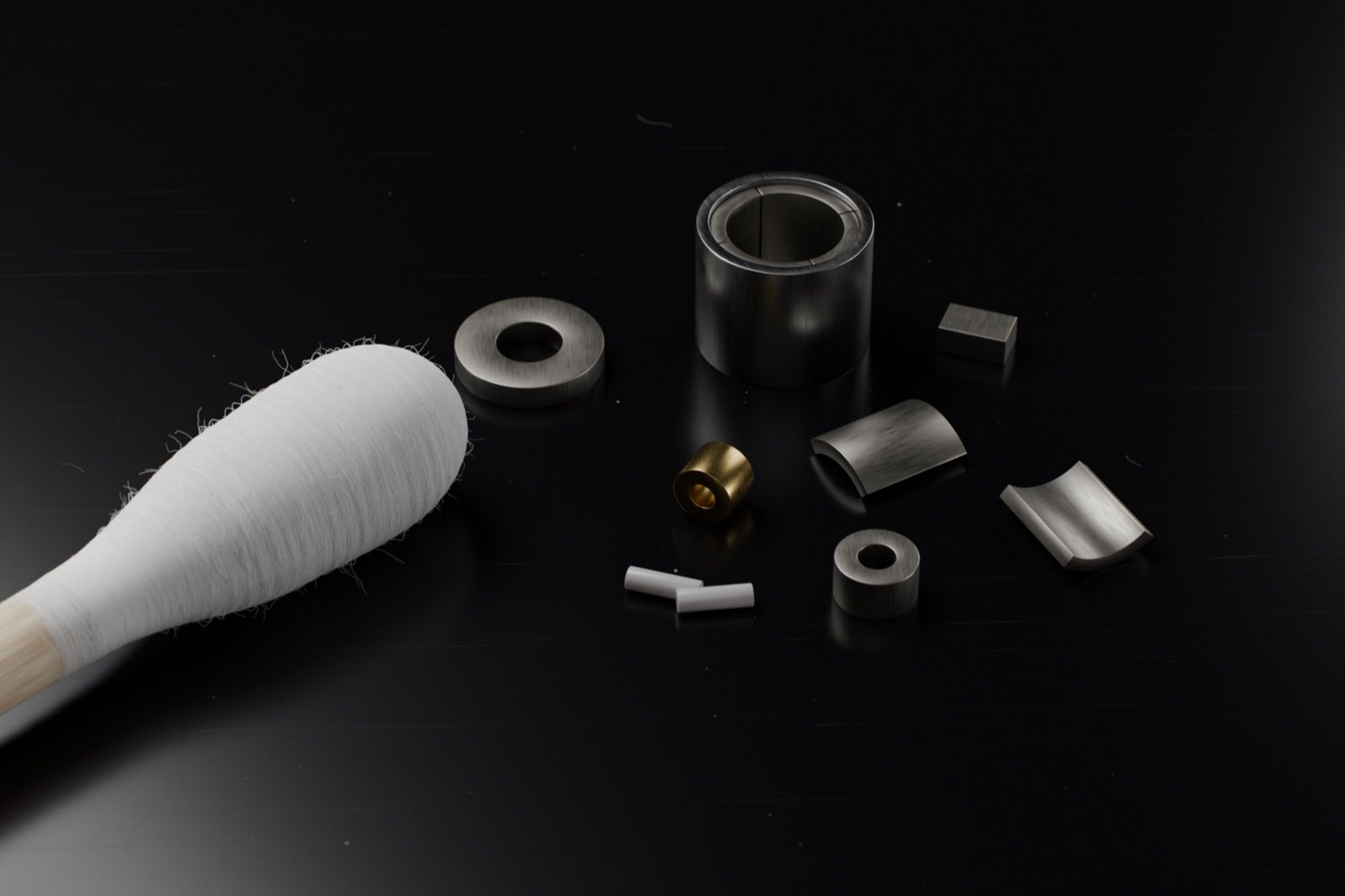
Size comparison with a cotton bud: assembly in a stainless steel sleeve, ring, disc, segment, rod and block magnets.
Applications
Where micromagnets are used

Catheters and endoscopy
Drives, couplings and position sensing in the smallest cross-section
Surgical instruments
Holding and switching magnets, sensor magnets for position detection
Micropumps
Rotor magnets and couplings, for example in blood and dosing pumps
Active implants
Encapsulated magnets for positioning and coupling
FAQ
Frequently asked questions about micromagnets
How small can magnets be made?
We make magnets from an outer diameter of approx. 0.4 mm. We have already produced ring magnets with bores down to Ø 0.16 mm. What is possible in each case depends on material, geometry and tolerances.
How are micromagnets measured?
We measure the geometry on the part itself, 100 % on request. As is usual in the industry, we determine the magnetic properties on a standard test specimen from the same batch. Hysteresis curves can hardly be measured reliably on parts of this size.
Which coating suits micromagnets?
Parylene C typically adds only approx. 5 to 10 µm and covers edges and bores evenly. Gold is an option for contact applications, as a nickel strike plus flash gold with approx. 10 µm in total. On micromagnets every coating counts towards the tolerance, so we set the thickness within the project. You will find a comparison on the page on coated magnets.
NdFeB or SmCo for micromagnets?
NdFeB delivers the highest energy density and therefore the most force in the smallest space. SmCo is more temperature-stable and more resistant to corrosion. Steam sterilization is also possible with NdFeB, however, if grade and coating are right. Since April 2025, SmCo and NdFeB containing dysprosium or terbium need an export licence from China. The authority has up to 45 working days to decide, it often takes longer, and the rules change with politics.
From what quantity do you make micromagnets?
Technically from one piece. Because set-up and inspection make up a large part of the cost, samples usually only pay off from a small batch size. We discuss with you what quantity makes sense for your trials.

What we need for a quotation
For micromagnets, what helps us most is a drawing, even if it is not yet released, and the quantity for the first samples. Tolerances and coating thickness often decide whether a part is feasible.
Talk to an expert
Your contact for medical technology
Talk to us about your project. We are happy to advise you personally.

Patrick Muschak
Sales Engineer Medical & Life Sciences

Philippe Scheuber
Head of Sales