

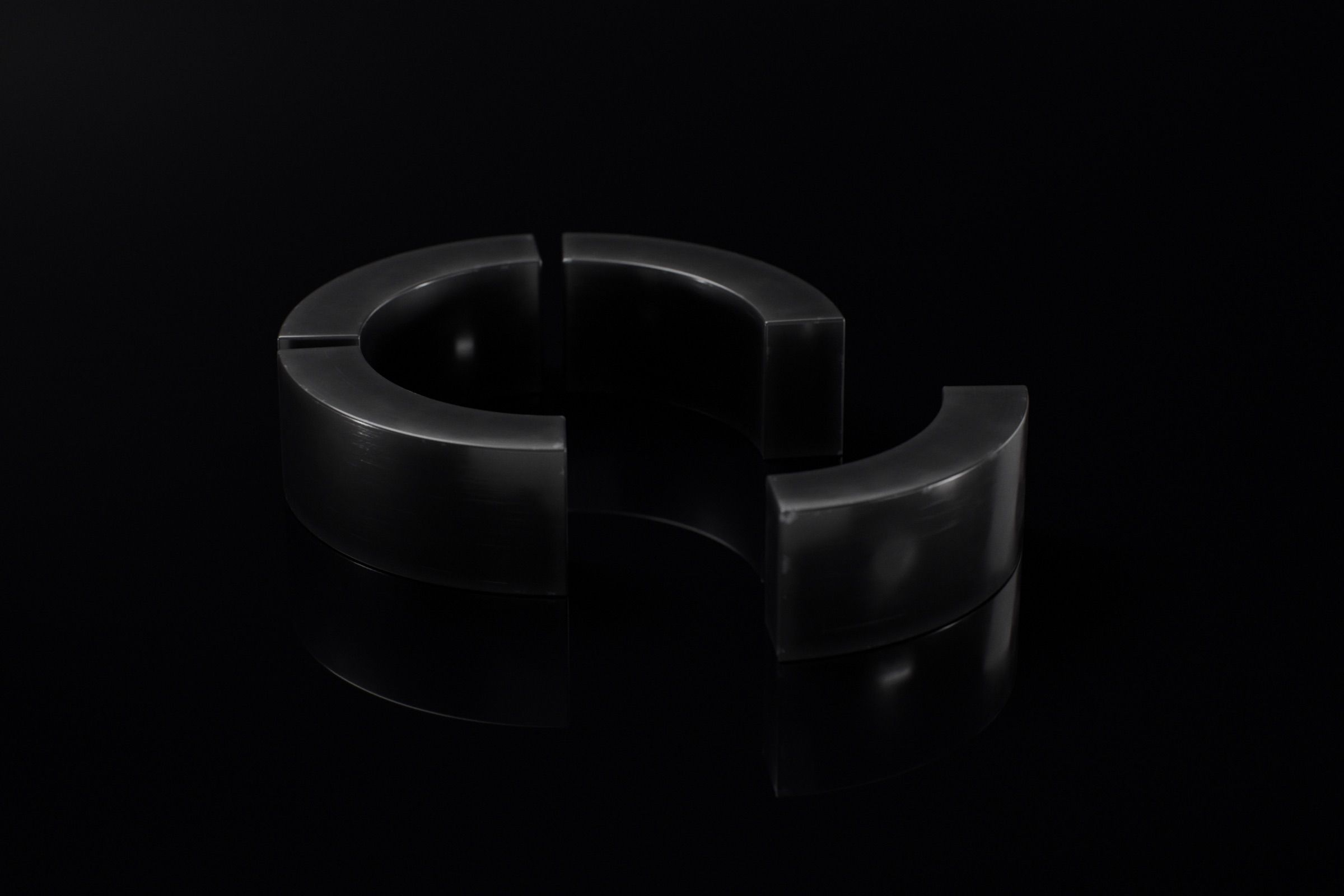
Segment magnets assembled into a ring. This is how the magnet rings of many coaxial couplings are built.
Principle
How a magnetic coupling works
An inner magnet sits on the motor shaft in the closed drive housing. An outer magnet sits in the driven part, for example in the impeller of a pump. Between them is a sealed wall with no shaft passing through it. The magnetic field transmits the torque through this wall.
- Drive side – inner magnet: on the motor shaft, in the closed housing with winding and bearings
- Separating wall: e.g. titanium or plastic, no shaft passes through
- Medium side – outer magnet: in the impeller or the driven part, in the medium
Advantages and types
Why medical devices use magnetic couplings


No leakage
Without a shaft feedthrough there is no sealing gap through which medium can escape or lubricant can get in.

No seal wear
There is no shaft seal that wears out or produces frictional heat in the medium.

Drive and medium kept apart
Motor and electronics stay in their own housing. This makes cleaning and sterilization easier.

Tool-free exchange
Disposables, pump heads or attachments can be coupled magnetically and replaced without tools.
Types at a glance
| Type | Construction | Typical use |
|---|---|---|
Coaxial coupling | Inner and outer ring, radially magnetized or multipole, cylindrical gap | Blood pumps, pumps with a tubular containment can |
Face (axial) coupling | Two multipole discs, flat gap | Flat installation spaces, pump heads, laboratory stirrers |
Holding coupling | Magnet pair without torque transmission, for holding and aligning only | Exchangeable attachments, disposables, positioning |
Design
Which parameters define the coupling
We design couplings with FEM simulation. If a prototype already exists, we first model it and check the model against measured values. Only then do we optimize.
| Parameter | Effect | What we need from you |
|---|---|---|
Torque | Determines magnet volume, number of poles and material. A reserve keeps the coupling from slipping. | Nominal and peak torque |
Gap and wall thickness | Torque drops sharply as the distance grows | Wall thickness, bearing clearance, tolerances |
Wall material | Ferromagnetic materials divert the field. Electrically conductive walls cause eddy current losses at high speed. | Material of the wall and of all parts in the field |
Speed | Eddy currents, heating, imbalance | Operating speed and load profile |
Temperature | Coercivity falls as temperature rises, much faster for NdFeB than for SmCo. Process heat during overmolding counts as well. | Operating and process temperatures |
Installation space | Limits the magnet volume and therefore the achievable torque | Drawing or installation space |
Material selection
NdFeB or SmCo?
At room temperature, NdFeB and SmCo are often close in coercivity. The difference is the temperature coefficient: NdFeB loses around 0.5 to 0.6 % per kelvin, Sm2Co17 around 0.2 to 0.3 %. The coercivity of NdFeB therefore drops about two to three times as fast. The warmer it gets, the faster NdFeB falls behind.
The usual remedy is dysprosium or terbium. But that brings the export licence back. That is why we first look for solutions through geometry and process.
| NdFeB without Dy/Tb | SmCo | |
|---|---|---|
Remanence | higher | lower |
Temperature stability | lower | higher |
Corrosion | coating required | more resistant |
Export licence from China | currently not required | required |

Case study
From 6 to 4 mm, without an export licence
How we shrank the magnetic coupling of an intravascular blood pump, overmolded the magnet into the impeller and secured the supply.
FAQ
Frequently asked questions about magnetic couplings
What happens under overload?
If the load torque exceeds the torque the coupling can transmit, the coupling slips without mechanical damage. The drive then has to resynchronize. That is why we plan a reserve above the peak torque in the design.
Which material is suitable for the separating wall?
The wall should not be ferromagnetic, otherwise it diverts the field. Titanium and plastics are common. Electrically conductive walls such as titanium cause eddy current losses at high speeds, which we take into account in the design. Ferromagnetic stainless steels nearby, such as AISI 416, also belong in the simulation model.
How much torque can a magnetic coupling transmit?
That depends mainly on magnet volume, gap and material. In medical technology the range goes from fractions of a millinewton metre in micropumps to much higher values in laboratory equipment. We calculate it for your installation space.
Can the magnet be overmolded directly into the impeller?
Yes. This saves an assembly step. The plastic surrounds the magnet where the wall is thick enough. Where it is too thin, a 316L sleeve forms the outer wall and the plastic closes the end faces, as in our case study. Because process heat can weaken a magnetized NdFeB magnet, we design material and process together. More on this under Magnet assemblies.
Does a coupling magnet need an export licence?
Since April 2025, SmCo and NdFeB containing dysprosium or terbium need an export licence from China. The authority has up to 45 working days to decide, it often takes longer, and the rules change with politics. NdFeB without these heavy rare earths currently needs no licence. Our case study shows how to switch a coupling from SmCo to licence-free NdFeB.
What we need for a quote
For a coupling, we mainly need the operating data: torque, speed, temperatures, wall thickness and gap. With these we make the first design.
Talk to an expert
Your contact for medical technology
Talk to us about your project. We are happy to advise you personally.

Patrick Muschak
Sales Engineer Medical & Life Sciences

Philippe Scheuber
Head of Sales